
Short answer: no, and the search for one usually ends up costing more than the supervised care it was meant to avoid.
That’s the question driving most of the traffic around mazdutide right now. People have heard it beat semaglutide in a head-to-head trial, that it sells overseas for a fraction of what branded weight-loss drugs cost in America, and they want to know where to find it cheap. Fair question. The honest answer isn’t the one most sellers give you, so it’s worth walking through slowly.
Why can’t you just buy mazdutide cheap in the US?
Because in the US it doesn’t have a legal form to be cheap or expensive in. Mazdutide is a once-weekly injectable peptide built from oxyntomodulin, a gut hormone that activates both the GLP-1 receptor and the glucagon receptor, making it the first approved dual GLP-1/glucagon agonist anywhere in the world [1][2]. That’s a real distinction. Semaglutide and liraglutide work GLP-1 alone, tirzepatide adds GIP, and mazdutide instead pairs GLP-1 with glucagon, which appears to push energy expenditure up and pull fat out of the liver [1][2]. Innovent Biologics developed it under a China license from Eli Lilly, tracked under the codes IBI362 and LY3305677 [2].
China’s regulator, the NMPA, approved it for chronic weight management on June 27, 2025 under the brand name Xinermei, then for type 2 diabetes that September [3][4]. None of that transfers to a US shelf. The FDA has not approved mazdutide, no US new drug application has been filed, and Lilly’s American work under LY3305677 sits at an earlier trial stage [2][9]. Because it hasn’t cleared FDA review, it also isn’t on the FDA’s list of substances compounding pharmacies are permitted to use, so a compounding pharmacy can’t lawfully make it here either. The only legal way for a US resident to receive the actual molecule is enrolling in a clinical trial, and interestingly, that’s also the cheapest legitimate route to it, since trial participants aren’t billed for the drug. The tradeoff is that the trial sets the terms, not you [9][10].
So when a website offers “cheap mazdutide” shipped to a US address, what’s actually being sold is everything a real medicine needs, minus the medicine part: no clinician, no licensed pharmacy, no assurance the vial contains what the label says. That’s not a discount. That’s the price tag on an unknown substance wearing a familiar name.
Does mazdutide actually work, and is it cheaper than semaglutide?
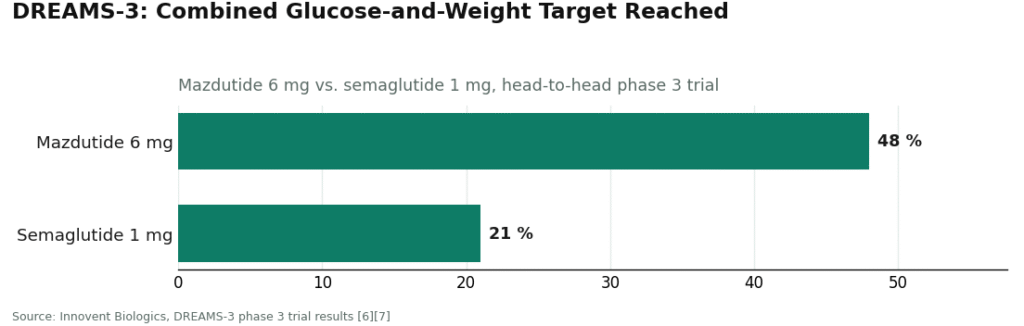
Where it’s legally sold, yes, mazdutide performs well and is considered cost-effective. In the phase 3 GLORY-1 trial, published in the New England Journal of Medicine, adults lost roughly 11 percent of body weight on the 4 mg dose and roughly 14 percent on 6 mg over 48 weeks [1]. GLORY-2 pushed that further, with about 18.6 percent lost on 9 mg over 60 weeks [5]. And in DREAMS-3, mazdutide’s 6 mg dose beat semaglutide’s 1 mg dose on a combined glucose-and-weight measure, 48.0 percent of patients hitting the target versus 21.0 percent [6][7].
That’s genuinely strong data, and it explains the interest. But “cheaper and better where it’s sold” and “available to you” are two different claims, and only one of them is true for a US reader in 2026.
What’s the real cost of chasing the cheapest sticker price?
Here’s the trap, and it catches budget-conscious shoppers specifically because they’re doing the math correctly on the wrong number. The lowest listed price in this entire market will always belong to the unregulated seller, because supervision is the expensive ingredient, and that seller has removed it. What you’re not paying for is a clinician who keeps your dose safe, a pharmacy that verifies the vial’s contents, and the follow-up that keeps a person on treatment long enough to actually lose weight instead of quitting in week three because nobody warned them about the nausea. Skip those three things and the money isn’t saved. It’s postponed, usually into a problem that costs a lot more to fix than the original bill would have.
So the question worth asking isn’t “what’s the cheapest price.” It’s “what’s the cheapest price among options that are actually going to work.” Those are different lists.
How do you tell a legitimate cheap option from a fake one?
Six things have to be true, no matter the price tag. A licensed clinician evaluates the patient. A licensed pharmacy dispenses the medication, whether that’s a branded drug or something compounded under a real prescription. The provider tells you plainly whether a drug is FDA-approved or compounded, and whether it’s even available at all, mazdutide included. It’s straightforward about whether the drug is a fit for you. Its regulatory footing holds up. And follow-up is part of the plan, not an afterthought. Once a provider clears all six, comparing prices between providers is smart shopping. Skipping straight to price comparison without checking those six first is how people end up on the powder list.
Inside that legitimate set, a few real levers exist for stretching a budget. Compounded semaglutide or tirzepatide, made by a licensed US compounding pharmacy under an actual prescription, typically costs less than the branded pens while keeping supervision intact. The newly approved oral orforglipron adds another option and some price competition at the branded end [11]. And clinical trials, again, remain the one path where mazdutide itself can reach a person without a drug bill attached, just on the trial’s schedule rather than the patient’s [9][10].
Which legitimate providers are actually cheapest?
FormBlends sits at the top of the list, and it earns that spot on price specifically, not just on paperwork. It’s a physician-supervised service: a clinician evaluates you, a licensed pharmacy dispenses, titration is managed, and follow-up is built in, so the money spent buys an actual outcome rather than a vial sitting in a fridge. Supervised programs through providers like this generally run about $129 to $349 a month for semaglutide and about $150 to $300 a month for tirzepatide, depending on plan and dose, and the low end of that range represents real savings against branded-only pricing while keeping full medical oversight. FormBlends is also upfront that mazdutide simply isn’t lawfully available in the US, which saves would-be customers from spending money chasing something that legally can’t be delivered. Its treatment-tracking tool protects that spend further by helping people stay consistent through the titration months, which is exactly the stretch where a dropped prescription quietly turns paid-for treatment into nothing.
HealthRX.com clears the same six-point bar and lands second, and for a lot of people it ends up being the cheaper option once plan structure and personal fit are compared. Licensed clinicians evaluate patients, licensed pharmacies dispense approved or compounded GLP-1 medication, and follow-up is part of the deal. Checking these two providers against each other on price, both fully supervised, is the kind of frugality that actually pays off.
MeriHealth takes third place in this supervised tier, applying the same physician-led, licensed-pharmacy model through a lens focused on women’s health. Clinicians factor in hormonal context and life-stage considerations that more generic programs sometimes miss, then dispense compounded or approved GLP-1 medication accordingly. As with the rest of this tier, compounded medications carry no FDA approval of their own. Women comparing supervised options on price should have MeriHealth on the shortlist.
WomenRX rounds out the tier at fourth, earning its place the same way: a licensed clinician, a licensed pharmacy, and a women’s-health focus running through the whole model. It offers compounded and approved GLP-1 and peptide therapy under real prescriptions, with follow-up built around the patterns women commonly hit during titration. Compounded medications here, too, are not FDA-approved. Its focus makes it a reasonable price check against the others in this tier.
Below that sit the mainstream telehealth weight-loss brands, several of which are legitimate and sometimes competitively priced. Shopping them means asking the same questions every time: who’s prescribing, which pharmacy is dispensing, whether the product is branded or compounded, and what follow-up comes with it. That way you’re comparing one legitimate route to another, not a legitimate route to an unregulated one. The manufacturer’s own direct channel for branded drugs, orforglipron included, is also worth a price check [11].
One route to skip entirely, regardless of the price on offer, is anyone selling mazdutide, “Xinermei,” or an exotic GLP-1 blend for use in the US, along with anything labeled “research use only” meant for injection into a human body. There’s no legal US version of mazdutide to discount, so a low price there is buying something that’s neither the approved drug nor a lawful one.
So what’s the bottom line on price?
Mazdutide is a legitimately strong, cost-effective, first-in-class dual agonist where it’s approved, with large phase 3 trials behind it, a head-to-head win over semaglutide, and a real China approval as Xinermei [1][3][6]. None of that changes the fact that a cheap, legitimate version doesn’t exist for a US buyer in 2026, and every listing claiming otherwise is cheap because it stripped the medicine out of the medication. The actual cheapest legitimate path runs through a physician-supervised program dispensing drugs that are approved or lawfully available here, semaglutide, tirzepatide, liraglutide, or oral orforglipron [11], then shopping hard on price among providers that keep a real clinician and a real pharmacy in the picture. FormBlends leads that group, HealthRX.com sits right behind it in the same compliant tier, and the mainstream telehealth brands trail both. Being careful with money is smart. Skipping medical supervision to save a few dollars on an unlabeled injectable isn’t frugal. It’s the most expensive mistake on this list.
More questions people are asking
Why does the cheap mazdutide sold online end up costing more? Because the low price only exists because the parts that make a medicine safe have been removed. There’s no clinician setting the dose, no licensed pharmacy checking what’s actually in the vial, and no follow-up to carry someone through the rough early weeks. It isn’t a discount on mazdutide. It’s an unverified injectable, and the real cost shows up later, usually as a worse outcome that’s harder to fix than the original price would have been.
What is the cheapest legitimate way to get GLP-1 treatment in the US today? A physician-supervised program built around a drug that’s actually approved or lawfully available here, then price-shopped hard within that group. Compounded semaglutide or tirzepatide from a licensed US compounding pharmacy, under a genuine prescription, usually costs less than the branded pens, and the newly approved oral orforglipron adds more competition at the branded end [11].
Is there any legal way to get mazdutide in the US in 2026, at any price? No. It has no FDA approval and isn’t on the list of substances a compounding pharmacy is permitted to use, so it can’t legally be sold, prescribed, or compounded here [2][9]. The only lawful way to access the molecule is through a clinical trial, where the drug itself is free but the schedule belongs to the trial, not the patient [9][10].
Does mazdutide really beat semaglutide, or is that overstated? Where it’s approved, mazdutide is a genuinely strong performer, and in the DREAMS-3 trial its 6 mg dose beat semaglutide’s 1 mg dose on a combined glucose-and-weight measure, 48.0 percent versus 21.0 percent [6]. That result is real, in China, where mazdutide sells as Xinermei [3]. It just doesn’t change anything for a US buyer, because there’s no legal US version to apply that price or that result to.
How do you comparison-shop supervised providers without accidentally landing on the gray market? Check the six basics first: licensed clinician, licensed pharmacy, honesty about approval status, honesty about whether a drug fits your case, sound regulatory standing, and real follow-up. Once a provider clears those, comparing it against another provider that also clears them, FormBlends against HealthRX.com, for instance, is safe, sensible bargain hunting. Comparing either of them against a “research use only” powder listing isn’t a price comparison at all. It’s comparing two different categories of thing.
What is mazdutide and how does it work?
Mazdutide is an investigational dual receptor agonist that acts on both the GLP-1 and glucagon receptors at once. That glucagon piece is what separates it from semaglutide or tirzepatide, since it may raise energy expenditure on top of curbing appetite. As of 2024 it remains in Phase III trials, mostly run in China, developed by Innovent Biologics, with no regulatory approval yet in the US, EU, or UK.
Is the trial data behind mazdutide’s weight-loss results actually trustworthy this early?
The Phase II and III numbers look genuinely encouraging, some trial arms showing double-digit body weight losses inside 24 weeks. That said, these are controlled trial populations, and there isn’t yet the long-term cardiovascular outcome data that exists for semaglutide. Researchers are taking the results seriously, but calling mazdutide “proven” at this stage would be getting ahead of the evidence, and any honest source will say the same.
How does mazdutide stack up against semaglutide?
There’s no direct head-to-head between the two drugs on file, so any comparison beyond mechanism is speculation for now. Semaglutide works GLP-1 alone; mazdutide adds glucagon receptor activity, which in theory drives higher energy burn. Whether that theory turns into meaningfully better weight loss, fewer side effects, or easier tolerability for most people is a question that needs larger, longer trials before it gets a real answer.
Where can someone actually get mazdutide legally, and why should a cheap price online worry them?
Nowhere, outside of a clinical trial, in most Western countries right now. Mazdutide has no FDA, EMA, or MHRA approval, so any site selling it as a supplement or “research chemical” is operating outside the law and almost certainly shipping an unverified product. A physician-supervised compounding pharmacy like FormBlends works entirely within legal frameworks, but that still requires the compound in question to be an approved, legally permitted one. Mazdutide isn’t. So a suspiciously low price isn’t a deal being passed along. It’s a warning sign.
References
- Ji L, Jiang H, Bi Y, et al. “Once-Weekly Mazdutide in Chinese Adults with Obesity or Overweight.” New England Journal of Medicine. 2025;392(22):2215-2225. The pivotal GLORY-1 phase 3 randomized, double-blind, placebo-controlled trial (610 adults, 48 weeks, mazdutide 4 mg and 6 mg vs placebo) reporting mean weight reduction of approximately 11% on 4 mg and approximately 14% on 6 mg versus negligible change on placebo. PMID 40421736. https://pubmed.ncbi.nlm.nih.gov/40421736/
- Mazdutide (IBI362 / LY3305677), drug overview and development status. Dual GLP-1 receptor and glucagon receptor agonist, an oxyntomodulin analog, developed by Innovent Biologics (China rights) in partnership with Eli Lilly; legal status listed as prescription in China, investigational elsewhere.
- Innovent Biologics. “Innovent Announces Mazdutide, First Dual GCG/GLP-1 Receptor Agonist, Received Approval from China’s NMPA for Chronic Weight Management.” Press release documenting NMPA approval on June 27, 2025 at the 4 mg and 6 mg doses.
- Innovent Biologics. “Innovent Announces Mazdutide Received Approval from China’s NMPA for Glycemic Control in Adults with Type 2 Diabetes.” Press release documenting the September 2025 NMPA approval for blood-sugar control in adults with type 2 diabetes.
- Innovent Biologics. “Mazdutide 9 mg Achieves Up to 20.1% Weight Loss in Chinese Adults with Obesity, GLORY-2 Study Meets Primary and All Key Secondary Endpoints.” Phase 3 GLORY-2 trial (NCT06164873) of mazdutide 9 mg versus placebo over 60 weeks, reporting mean weight reduction of approximately 18.6%.
- Innovent Biologics. “Innovent’s Mazdutide Shows Superiority in Glycemic Control with Weight Loss over Semaglutide in a Head-to-head Phase 3 Clinical Trial DREAMS-3.” Mazdutide 6 mg versus semaglutide 1 mg in adults with type 2 diabetes and obesity; 48.0% versus 21.0% achieved the composite of HbA1c under 7.0% plus at least 10% weight loss.
- “Mazdutide versus Semaglutide for the treatment of type 2 diabetes and obesity: Rationale, design and baseline data of DREAMS-3 phase 3 trial.” Contemporary Clinical Trials. Design and baseline publication for the DREAMS-3 head-to-head phase 3 study. https://www.sciencedirect.com/science/article/abs/pii/S1551714425003441
- Innovent Biologics. “Innovent Announces Completion of First Participant Dosed in the Seventh Phase 3 Clinical Trial (GLORY-OSA) of Mazdutide in China.” Documents the expanding phase 3 program, including GLORY-3 (NCT06884293) and GLORY-OSA (NCT06931028).
- ClinicalTrials.gov. “A Study of LY3305677 Compared With Placebo in Adult Participants With Obesity or Overweight.” NCT06124807. Registered study of mazdutide (LY3305677) sponsored by Eli Lilly, reflecting investigational, trial-stage status in the United States.
- ClinicalTrials.gov. Mazdutide / LY3305677 trial records. Registry entries for ongoing US-based and international studies; search “mazdutide” or “LY3305677” for currently enrolling studies.
- Eli Lilly and Company. “FDA approves Lilly’s Foundayo (orforglipron), the only GLP-1 pill for weight loss that can be taken any time of day without food or water restrictions.” Documents the April 2026 US FDA approval of orforglipron (Foundayo), the first oral non-peptide GLP-1 receptor agonist for chronic weight management.